Delivered in partnership with SYND

West Africa Youth Manifesto on Water Sovereignty

Across West Africa, water insecurity is worsening due to climate change, pollution, extractive industries, poor governance, rapid urban growth, and conflicts over natural resources. Countless individuals, particularly those in rural areas, as well as women, youth, and residents of informal settlements, do not have fair access to safe and affordable water. Concurrently, rivers, wetlands, groundwater sources, and coastal ecosystems face increasing threats from privatization, pollution, and unsustainable use. 

A regional Manifesto on Water Sovereignty is essential to reclaim water as a shared ecological and social resource instead of a commodity. It can enhance youth leadership, bolster community-driven governance, foster climate resilience, and hold governments, corporations, and regional bodies accountable. Most crucially, it can bring together various movements across West Africa into a unified agenda focused on justice, dignity, peace, and ecological sustainability.


The 8 key demands of the Water Manifesto are:

  1. Recognize Water as a Fundamental Human and Ecological Right

  2. Protect Rivers, Wetlands, Aquifers, and Coastal Ecosystems

  3. Reject Water Privatization and Commodification

  4. Advance Climate-Resilient Water Governance

  5. Center Indigenous and Community Knowledge Systems

  6. Ensure Youth and Women’s Leadership in Water Governance

  7. Promote Regional Solidarity and Transboundary Water Cooperation

  8. Demand Accountability from Governments and Polluting Industries
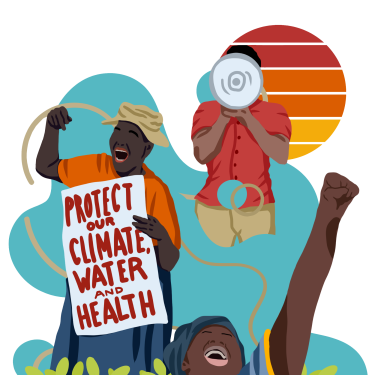
Collective Call to Action from West African Youth

To West African governments, public institutions, ECOWAS, the African Union, and regional water authorities:

We call on you to put people and the planet before profit, ensuring that water remains a fundamental right and a shared public good. Protecting water resources demands transparent governance, equitable access, and accountability to the communities
that depend on them. As our rivers, lakes, and aquifers cross
national borders, regional cooperation is indispensable to
preventing pollution, resolving competing demands, and
safeguarding water for future generations.

Water is our shared heritage, our collective responsibility, and our common future.

Eight Key Demands for the Manifesto:

  1. Recognize Water as a Fundamental Human and Ecological Right

    The manifesto calls for the legal and constitutional acknowledgment of water as a fundamental human right and a vital ecological resource. Availability of clean, safe, affordable, and adequate water should not be influenced by an individual’s income, location, or political standing. We demand that we place public welfare and environmental health above profit-focused water systems, ensuring that both individuals and nature have assured access to the water resources essential for survival and resilience.

  2. Protect Rivers, Wetlands, Aquifers, and Coastal Ecosystems

    West Africa’s water ecosystems are under severe pressure from mining, industrial pollution, deforestation, oil extraction, and unsustainable agriculture. The manifesto  calls for stronger environmental protections, restoration of degraded watersheds, and community-led conservation of rivers, wetlands, mangroves, and groundwater systems. Protecting ecosystems is essential not only for biodiversity, but also for food systems, livelihoods, climate adaptation, and regional peace.

  3. Reject Water Privatization and Commodification

    The manifesto rejects any policies that hand over public water systems to private corporations or regard water mainly as a marketable good. Privatization frequently exacerbates inequality and marginalizes vulnerable groups from obtaining essential services. Governance of water should be democratic, transparent, focused on the community, and accountable to the public, with investment aimed at ensuring equitable access instead of prioritizing profit.

  4. Advance Climate-Resilient Water Governance

    Shifts in climate are altering rainfall distribution, worsening droughts and floods, and exacerbating water shortages throughout the region. The manifesto calls for funding in infrastructure that can withstand climate challenges, early warning systems, sustainable farming practices, restoring watersheds, and decentralized water management. Authorities need to incorporate water equity into their climate adaptation and mitigation approaches while focusing on the needs of vulnerable communities that are more severely impacted by climate change.

  5. Center Indigenous and Community Knowledge Systems

    Indigenous peoples and local communities possess generations of knowledge on water conservation, ecosystem stewardship, and climate resilience. The manifesto demands recognition and integration of traditional governance systems, customary practices, and local ecological knowledge into formal water policies. Sustainable solutions must emerge from communities themselves, rather than being imposed through top-down or externally driven development models.

  6. Ensure Youth and Women’s Leadership in Water Governance

    Young people and women are among the most affected by water insecurity, yet they remain underrepresented in decision-making processes. The manifesto calls for institutional mechanisms that guarantee meaningful participation of youth and women in water governance at local, national, and regional levels. This includes representation in policy platforms, budgeting processes, climate negotiations, and transboundary water management initiatives.

  7. Promote Regional Solidarity and Transboundary Water Cooperation

    Major water bodies in West Africa cross national borders, making cooperation essential for peace, sustainability, and equitable resource sharing. The manifesto advocates for stronger regional governance frameworks that prevent resource conflicts and encourage collaborative stewardship of shared rivers, lakes, and aquifers. Water diplomacy must prioritize justice, ecological sustainability, and community rights rather than geopolitical competition.

  8. Demand Accountability from Governments and Polluting Industries
    Communities across the region continue to suffer from pollution, failed infrastructure, corruption, and weak enforcement of environmental regulations. The manifesto demands transparent monitoring systems, public access to water data, stronger environmental accountability laws, and penalties for polluters. Governments, multinational corporations, and development actors must be held accountable for actions that threaten public health, ecosystems, and water security.

The Manifesto is endorsed by the following entities:

  1. Savannah Zambia

  2. KADIRS

  3. Eco-Africa Network

  4. Green leaf Advocacy and Empowerment Center 

  5. Savañnah Zambia 

  6.  N-HYPPADEC (Formerly Niger State Ministry of Environment and Climate Change)

  7. Community And Family Aid Foundation-Ghana

  8. Climate Alaramma Sustainable Development Initiative (CASDI)

  9. Manica Youth Assembly 

  10. CONCERN FOR ACTION IN OUR COMMUNITY GHANA (CONFAC-GH)

  11. Amsan Farm Services 

  12. SPOTLIGHT ON ENVIRONMENT

  13. Aman HMO

  14. Alliance for Empowering Rural Communities

  15. Oko Forests 

  16. Youth in Natural Resources and Environmental Governance 

  17. Direct Impact development network 

  18. Afrihealth Optonet Association 

  19. Alliance for Empowering Rural Communities

  20. Our Lady of Perpetual Help Initiative (Amaclare Connect & Development Initiative)

  21. Community Development Initiative 

  22. Global Environmental and Climate Conservation Initiative

  23. Green Cycle Evolution Foundation

  24. Manica Youth Assembly

  25. Yendi Youth Parliament

  26. BISO PEUPLE

  27. Centre for Citizens Conserving Environment & Management (CECIC)

  28. Association for Farmers Rights Defense, AFRD

  29. ALLIANACE FOR EMPOWERING RURAL COMMUNITIES

  30. Gbolekekro Women Empowerment and Development Organization (GWEDO)

  31. Savañnah Zambia

  32. CEPRODE

  33. Centre for Coordination of Youth Activities

Download Full PDF of the West Africa Youth Manifesto on Water Sovereignty